
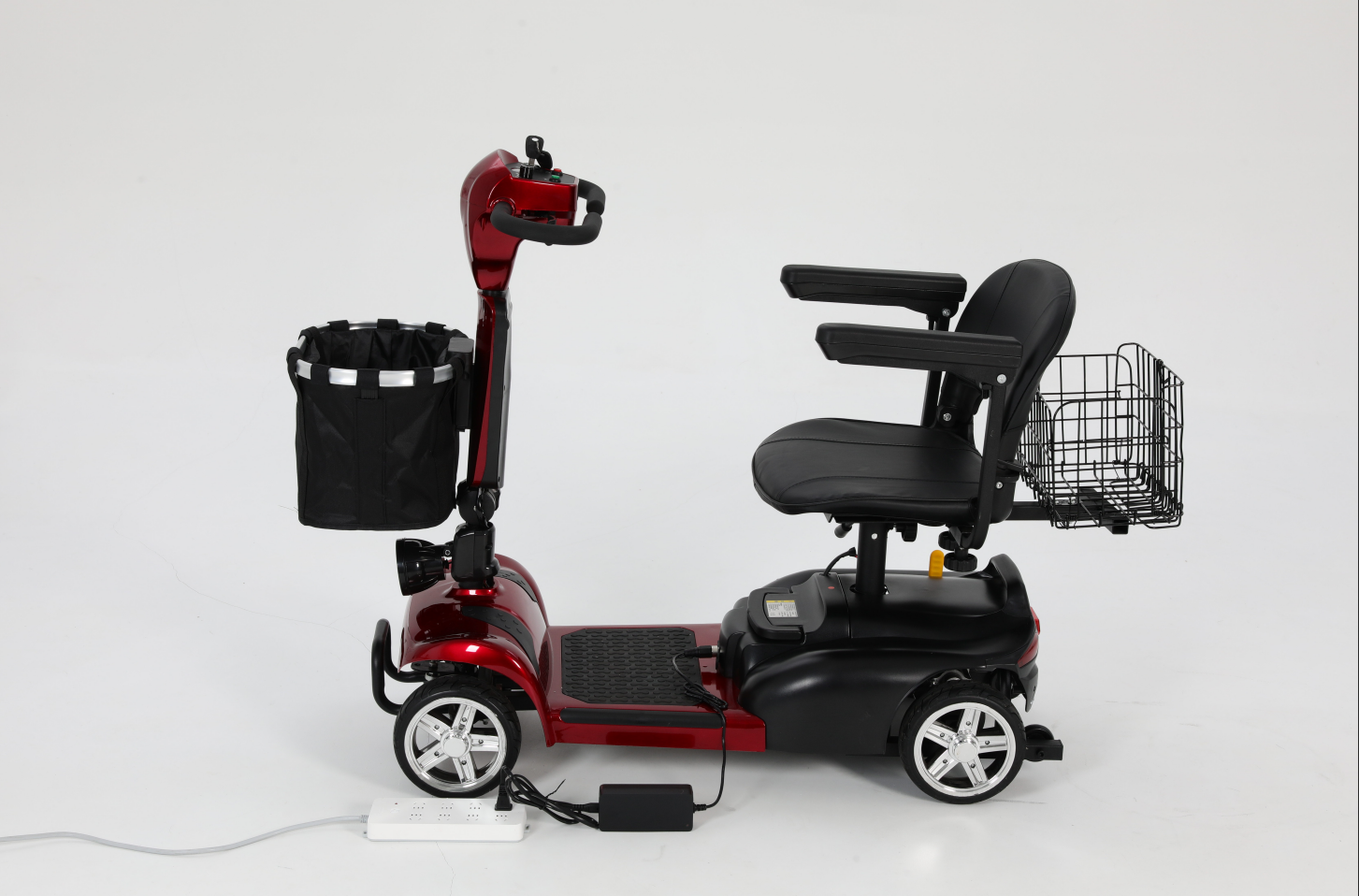
As the core driving component of modern micro-mobility, the health of a high-performance lithium-ion battery pack directly determines the range, power stability, and overall lifespan of your Ecomobi mobility scooter. Because elderly users are often influenced by older habits—such as the "drain before recharging" method common with traditional lead-acid batteries—they may accidentally cause irreversible capacity decay or safety hazards in modern lithium batteries.
This guide bridges the gap between electrochemical principles, BMS (Battery Management System) control logic, and high-frequency user scenarios to provide a definitive, scientific maintenance framework based on the "Three Do's and Four Don't's" rule.
I. Daily Operational Management: The "Three Do's"
Unlike traditional lead-acid batteries, lithium-ion batteries feature zero memory effect, high energy density, and low self-discharge rates. Maintaining the stability of their internal electrochemical structure requires following a routine of healthy charging habits.
1. DO Adhere to Shallow Charging & Discharging (Frequent, Light Cycles)
- Technical Principle: The cycle life of a lithium battery is highly dependent on its Depth of Discharge (DoD). Deep discharging (e.g., draining the battery below 15%) causes severe structural deformation of the cathode and anode materials, accelerating active lithium loss and electrode degradation.
-
Operational Standard: Break the habit of "using it until it's empty." Instead, adopt a "frequent, light charging" pattern. Plug the scooter in to charge as soon as you return from daily trips. Keeping the battery capacity within its optimal zone of 20% to 80% during daily use will maximize its rated cycle life.

2. DO Maintain a "Half-Charged" State for Long-Term Storage
- Technical Principle: Storing a lithium battery at a full 100% charge for a long time accelerates electrolyte decomposition and passivates the cathode (increasing internal resistance). Conversely, storing it at 0% is equally dangerous; natural self-discharge can pull the voltage below the critical threshold, permanently bricking the battery (known as a "starved" battery).
- Operational Standard: If the scooter is going to sit idle for an extended period (such as during winter or extended travel), adjust the battery level to around 50% (approx. 3.7V - 3.8V per cell). Store the scooter or battery in a cool, dry, well-ventilated indoor area. You must top it off back to a 50% state every 1 to 2 months to counteract natural self-discharge.
3. DO Use Only the Original Factory Charger
- Technical Principle: The original Ecomobi charger features precise Constant Current (CC) to Constant Voltage (CV) transition control logic, managed by a microchip specifically calibrated for your battery pack. Third-party or low-quality universal chargers often introduce excessive ripple currents and voltage drifts that can easily breach and damage the BMS defenses.
-
Operational Standard: Never mix and match chargers from old electronics, and avoid cheap, uncertified universal chargers. Always use the designated factory charger to ensure the output parameters perfectly match the battery pack's input requirements.

II. Core Safety Prohibitions: The "Four Don't's"
Controlling environmental variables and physical states is crucial to preventing electrochemical thermal runaway and sudden drops in battery capacity.
1. DON'T Over-Discharge the Battery (Avoid the Critical Low Threshold)
- Chemical Hazard: When the dashboard triggers a low-battery speed restriction or begins flashing a warning, the battery voltage is nearing its cutoff limit. Continuing to force the scooter to run under load causes the copper foil of the anode current collector to dissolve. When recharged later, it forms copper dendrites that can pierce the separator, causing an internal short circuit.
-
Operational Standard: Stop driving immediately and plug the scooter in as soon as the low-battery warning appears. Never repeatedly restart the scooter after it automatically shuts down just to squeeze out the remaining power.

2. DON'T Charge or Discharge in Extreme Temperatures
Lithium ions are highly sensitive to temperature. Their optimal operating and charging window is between 15°C and 35°C (59°F - 95°F).
- High-Temperature Danger (>45°C / 113°F): In the summer, never charge the battery in direct sunlight, inside a sealed car trunk, or in an unventilated storage shed. High temperatures accelerate electrolyte oxidation and cause gassing.
-
Low-Temperature Danger (<0°C / 32°F): In freezing conditions, lithium ions struggle to embed into the anode, forming hard metallic lithium dendrites on the surface. Forcing a high-current charge at this time will pierce the internal separator. Correct Approach: When bringing the scooter inside from the freezing cold, let it sit idle for 30 to 60 minutes. Wait until the battery pack warms up to room temperature before plugging it in.

3. DON'T Charge While the Battery Is Under Heavy Load
- Technical Principle: For Ecomobi models that feature a removable battery pack, some users might attempt to use the battery as an external DC power source (via an inverter) while it is plugged into the wall. Drawing high power while simultaneously feeding a charge current creates a compounding heat effect inside the cells, easily breaching the BMS temperature limits.
- Operational Standard: During a charging cycle, ensure the battery remains purely offline (suspended) and disconnected from any external parasitic loads.
4. DON'T Ignore Physical or Mechanical Abnormalities
- Safety Risk: Regardless of the battery's packaging style, swelling (bloating) caused by internal gas release, fluid leaks from seal failure, or structural deformation from physical impacts are absolute indicators of internal chemical side-reactions or micro-shorts.
- Operational Standard: While wiping down the scooter or removing the battery, if you notice swelling, leaking, a cracked casing, a burnt odor, or intense heat during charging, cut the power and stop using it immediately. Do not attempt to charge it again. Move it to an open, safe outdoor area away from flammables, and contact professional support for an inspection.
III. Tech Insights: Efficient Charging & Maximizing Lifespan
To help you better understand your daily operations, here are two important technical facts regarding modern lithium battery performance:
1. Understanding Modern Lithium Charging Stages
Ecomobi chargers feature indicator lights (changing from Red to Green) to show charging status. This operates via two main phases:
- Constant Current (CC) Stage: When the battery is low, the charger injects power at a steady, high current rate (the light stays Red). This is the fastest, most efficient phase.
- Constant Voltage (CV) Stage: Once the battery reaches roughly 80%–90%, the charger locks the voltage and gradually scales down the current for a "trickle finish" to protect the cells from overvoltage (the light turns Green or prepares to shift).
- Pro-Tip: Once the charger turns green, the battery has reached over 95% capacity and is ready for use; you can safely unplug it. Modern lithium batteries do not need to sit on the charger for hours after turning green; leaving them at maximum voltage for too long can actually accelerate aging.
2. Myth Busting: Do I Need to Periodically "Fully Charge and Discharge" the Battery?
- The Short Answer: No.
- Where the Myth Comes From: Old advice like "charge a new device for 12 hours the first three times" or "drain the battery completely once a month to calibrate it" applies only to older-generation Nickel-Metal Hydride (Ni-MH) or Nickel-Cadmium (Ni-Cd) batteries, which suffered from a "memory effect."
- The Scientific Reality: Lithium-ion batteries have absolutely no memory effect. Their lifespan is measured in "charge cycles" (meaning a full cycle is only logged when 100% of the total capacity is used up cumulatively, not every time you plug it in). In reality, "charge as you go, avoid over-filling, and never leave it dead" is the golden rule for lithium care.
IV. Troubleshooting Common Charging Abnormalities
If you run into an unexpected issue during daily charging, use the following quick references to diagnose the problem:
1. The charger light doesn't turn on when plugged in.
- Potential Root Cause: The wall outlet has no power, there is a loose connection, or the charger's internal fuse is blown.
- Recommended Solution: Try a different household wall outlet. If the outlet is working normally, the original charger needs to be replaced.
2. The light flashes green or alternates red/green when connected to the scooter.
- Potential Root Cause: The charging port is loose, it is not fully locked in, or the battery BMS has triggered temperature or overvoltage protection.
- Recommended Solution: Unplug and securely re-insert the cable, ensuring the clip clicks into place. If you just finished riding, let the battery cool down for 30 minutes before trying again.
3. Charging time is abnormally short (e.g., turns green in 30 mins).
- Potential Root Cause: The battery is experiencing a "surface charge" ("false voltage") effect, indicating internal cell imbalance or severe capacity degradation.
- Recommended Solution: This is a symptom of an aging battery. While still usable for very short trips, it is recommended to contact customer service for a cell balancing check.
4. The battery emits a strange smell or becomes burning hot during charging.
- Potential Root Cause: The extension cord or power strip is overloaded and overheating, or internal cells are damaged, causing excessive internal resistance.
- Recommended Solution: Unplug the main power supply immediately! Stop charging, move the battery or scooter outdoors to an open area away from flammable materials, and contact professional support.
💡 Summary
Developing scientific battery management habits saves you from expensive replacement costs and serves as the foundation for daily riding safety. We highly recommend that family members assist elderly riders in periodically checking their charging environments—making sure wall outlets are secure and free of surrounding clutter—so that every trip is backed by top-tier safety.



1 comment
Lillian Durfee
How long is the typically take to charge the battery for the first time?
Leave a comment
This site is protected by hCaptcha and the hCaptcha Privacy Policy and Terms of Service apply.